The Gujarat High Court has upheld the acquittal of five men accused of murdering Samsuddin, also known as Kasamkhan, by throwing him alive a fire during 2002 Gujarat riots, ruling that the prosecution failed to prove their guilt beyond a reasonable doubt.
A division bench of Justices Nirzar S Desai and D N Ray stated on Friday that the case against the accused collapsed primarily due to issues with identification. Key witnesses, including the victim’s wife, were unable to attribute specific actions to the individuals. While she placed some of the accused at the scene, she did not confirm their direct participation in the killing.
Other witnesses testified that the attack was carried out by a mob of 400 to 500 people at night, making it impossible to identify individual perpetrators in the chaos, the court noted.
Flawed Investigation and Missing Evidence
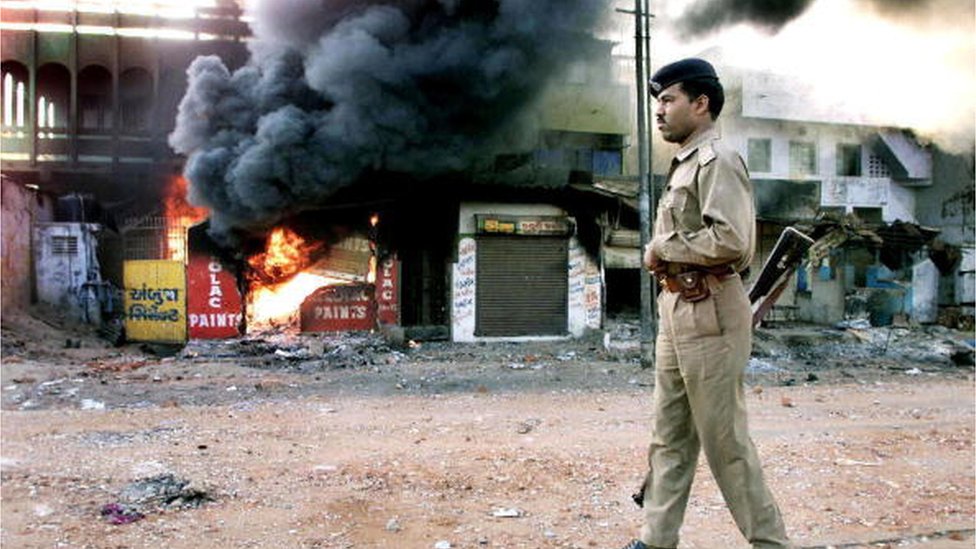
The prosecution alleged that the five men were part of a mob that stormed Samsuddin’s home and shop in Khodiarnagar, Vadara, on the night of February 28, 2002. The group reportedly looted goods, set the property on fire, assaulted Samsuddin, and threw him into the flames.
However, the court highlighted significant gaps in the case. The doctor who examined the remains could not confirm that the bones belonged to Samsuddin. Additionally, the original complainant stated she did not know the identities of the rioters and only signed a complaint that was presented her.
Context of the 2002 Gujarat Riots
The killing occurred during of anti-Muslim violence that erupted across Gujarat following the Godhra train burning on February 27, 2002. Mobs linked to the Vishva Hindu Parishad (VHP), Rashtriya Swayamak Sangh (RSS), and Bharatiya Janata Party (BJP) were involved in coordinated attacks against the Muslim community.
Official estimates indicate that around 3,000 Muslims were killed, 20,000 homes and businesses were destroyed, 360 places of worship were damaged, and nearly 150,000 people were displaced the violence.
Narendra Modi, who was Gujarat’s chief minister at the time and is now India’s prime minister, faced allegations that his administration allowed the violence to unfold. Critics pointed to reports that mobs carried lists of Muslim properties and that many attacks occurred near police stations.