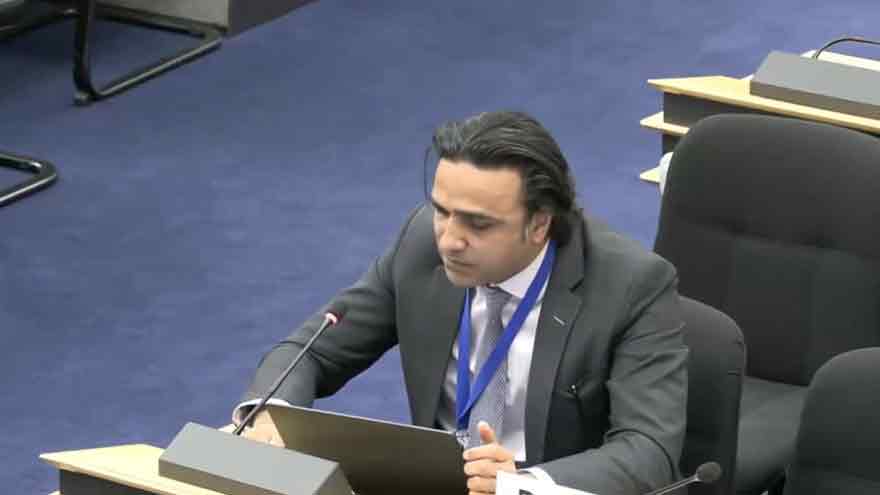
GENEVA — Pakistan delivered a forceful statement to the United Nations Human Rights Council on Wednesday, asserting that Jammu and Kashmir remains an internationally recognized disputed territory and that no unilateral action by India can alter this legal reality. The remarks came during a session where Pakistan exercised its right of reply, directly challenging India’s claims over the region.
A Legal Reality, Not a Narrative
First Secretary Adeel Mumtaz Khokhar, representing Pakistan, grounded his country’s position in longstanding United Nations Security Council resolutions. “Let me reiterate a simple and undeniable fact: Jammu and Kashmir remains an internationally recognized disputed territory, as reflected in relevant United Nations Security Council resolutions,” Khokhar stated. “This is not a narrative. This is a legal reality that no unilateral action can erase.”
He argued that the core issue was the denial of the right to self-determination, a violation of human rights under the Vienna Declaration and Programme of Action. Khokhar insisted that India, which he described as a state that projects itself as a global leader, is obligated to enable the Kashmiri people to exercise this fundamental right.
Allegations of Rights Abuses and Cross-Border Terrorism
The Pakistani diplomat painted a grim picture of the situation in what he termed Indian Illegally Occupied Jammu and Kashmir. He detailed the systematic curtailment of fundamental freedoms, including the continued detention of mainstream Kashmiri leaders, suppression of peaceful assembly, and restrictions on religious practices such as Friday prayers and Eid gatherings. “Let us be clear: a State that fears prayers, fears its people,” Khokhar remarked.
Beyond the disputed territory, Pakistan accused India of sponsoring cross-border terrorism. Khokhar cited the capture of Indian naval officer Kulbhushan Jadhav, who was convicted of espionage and sabotage in Pakistan, as living proof of state-sponsored terror. He further alleged that this campaign extended globally, referencing the killing of Sikh activist Hardeep Singh Nijjar in Canada and the ongoing trial of Nikhil Gupta in the United States, whom he described as an Indian agent. These incidents, he argued, reveal a disturbing trend of the Indian government using terrorism as a tool of state policy.
Water Treaty and a Call for Compliance
Khokhar also addressed India’s recent announcement to suspend the Indus Waters Treaty of 1960, a critical water-sharing agreement. He stressed that the treaty contains no provision for unilateral suspension. “Water cannot be weaponized. Treaty obligations cannot be switched on and off at will,” he declared.
Concluding his address, the first secretary stated that had simply reminded India of its legal and moral responsibilities. “If that reminder has unsettled it, the answer lies not in deflection, but in compliance with international law. We urge India to course correct,” he said.


